
What Is Plinko and Where Did It Come From
The original Plinko was a physical game introduced on The Price Is Right in 1983. Contestants dropped large circular discs down a pegboard, and the discs would bounce unpredictably between the pegs before landing in one of several slots at the bottom, each with a different prize value. The game became one of the most popular segments in the show's history precisely because the outcome was visually dramatic and genuinely unpredictable.
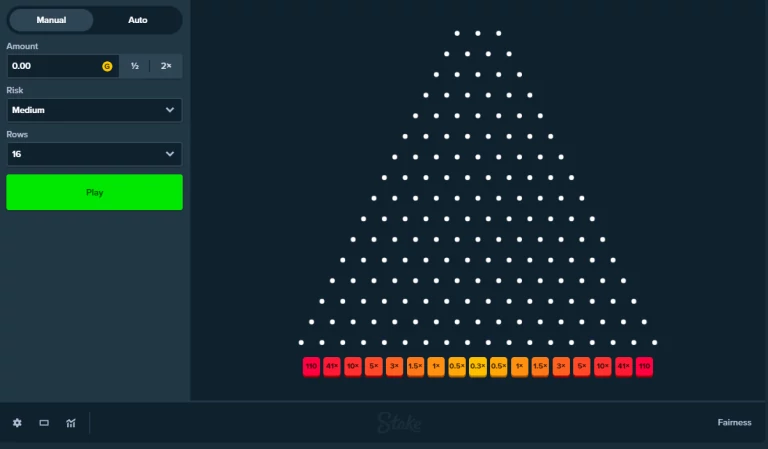
The casino version captures the same fundamental mechanic and translates it into a digital format with the addition of configurable variables. Online Plinko, as offered by providers such as Stake Originals, Spribe, and BGaming, allows players to set their bet amount, choose the number of rows on the board, and select a risk level that determines the distribution of multipliers across the bottom slots. These additions transform a passive entertainment format into a game with genuine strategic dimensions.
Plinko belongs to the broader category of crash and casual casino games — similar in spirit to dice games — a relatively new genre that has grown rapidly alongside the expansion of cryptocurrency gambling platforms. These games distinguish themselves from traditional slots and table games by offering more transparent mathematics, faster gameplay, and configurable risk parameters that put more structural decisions in the player's hands. Plinko is the most prominent example of this genre and the entry point for most players exploring it.
The Basic Rules of Plinko
The rules of Plinko are straightforward. A ball is placed at the top center of a triangular board covered with pegs arranged in staggered rows. When released, the ball falls through the peg field, deflecting left or right each time it strikes a peg. After passing through every row of pegs, the ball lands in one of a series of numbered buckets arranged along the bottom of the board. Each bucket displays a multiplier value, and your bet is multiplied by that value to determine your payout.
If you bet $5 and the ball lands in a bucket showing 3.2, you receive $16. If it lands in a bucket showing 0.3, you receive $1.50. If it lands in the center bucket on a low-risk board showing 1.0, you receive your $5 stake back exactly. The calculation is always the same: bet amount multiplied by the bucket multiplier equals the payout.
The ball's path through the peg field is determined by a random number generator. On provably fair platforms, the exact method by which the random outcome is generated is disclosed and verifiable using cryptographic techniques, allowing any technically literate player to confirm that the results cannot be manipulated by the operator. Each peg interaction is independent: at every peg, the ball has a probability of going left or right that is fixed and equal for each direction in the standard implementation. The accumulated effect of these independent random choices produces the distribution of outcomes across the bottom buckets.
Board Configuration: Rows and Their Effect on Outcomes
The number of rows on the Plinko board is one of the two primary configuration variables, and it has a significant effect on how outcomes are distributed. Most online Plinko implementations allow players to choose between 8 and 16 rows, with some platforms extending to 20 rows or beyond.
With fewer rows — say, 8 — there are fewer pegs for the ball to interact with, fewer possible paths the ball can take, and therefore fewer possible landing positions at the bottom. The distribution of outcomes across those positions is less bell-shaped and more spread out. Variance is higher on a per-drop basis, because the mathematical convergence toward the center that the bell curve produces requires more peg interactions to become pronounced.
With more rows — 14, 15, or 16 — the ball interacts with many more pegs. The central limit theorem, which describes how the sum of many independent random events tends toward a normal distribution, begins to exert stronger influence. The probability of the ball landing near the center of the board increases, the probability of extreme edge landings decreases, and the overall outcome distribution becomes more tightly clustered. For players running extended automated sessions, higher row counts produce more predictable aggregate outcomes that converge to the expected value more consistently than lower row configurations.
Choosing between row counts is ultimately a question of how much short-run variance you want per drop. More rows means a smoother, more predictable session. Fewer rows means more dramatic individual drop outcomes in both directions.
Risk Levels Explained: Low, Medium, and High
The risk level setting is the most consequential configuration decision a Plinko player makes. Unlike the number of rows, which affects the mathematical shape of the probability distribution, the risk level directly controls the multiplier values assigned to each bucket — and by doing so, it controls the fundamental trade-off between win frequency and win magnitude.
On a low-risk board, the multiplier values are distributed to reflect the underlying probability curve. Buckets near the center, where the ball is most likely to land, show modest multipliers close to 1. Buckets near the edges, which the ball reaches less often, show higher multipliers — but not dramatically so. The practical effect is a game where wins occur frequently, losses are mild, and the bankroll changes gradually over time. For players who want to play for an extended period without dramatic swings in either direction, low risk is the appropriate setting.
On a medium-risk board, the center multipliers drop to values below 1 — meaning a center landing now results in a small net loss — while the edge multipliers increase substantially. The game becomes less forgiving of average outcomes and more rewarding of the ball reaching the outer buckets. Win frequency drops, the size of wins when they occur increases, and session volatility rises. Medium risk is suitable for players with a moderate bankroll who want meaningfully larger win potential without committing to the extremes of high-risk play.
On a high-risk board, the transformation is dramatic. Center buckets may show multipliers of 0.2 or even 0.1 — meaning a ball landing near the center loses 80% to 90% of the bet. But edge buckets on a 16-row high-risk board can show multipliers of 1,000 or higher. The game becomes, in essence, a bet on an extreme statistical outlier. The vast majority of drops result in significant losses; the rare edge landing delivers an outsized win that can offset dozens of losing drops in a single result. High-risk Plinko requires a substantial bankroll, a high tolerance for losing streaks, and a clear-eyed acceptance that catastrophic session outcomes are normal and expected within this configuration.
It is critical to understand that the risk level does not change the game's RTP. The expected value of each bet — the long-run mathematical return per dollar wagered — is identical across all three risk settings on the same platform. What changes is the distribution of how that return is delivered: smoothly and frequently on low risk, dramatically and occasionally on high risk. Choosing a risk level is not choosing better or worse odds; it is choosing the shape of the probability distribution you want to experience.
The Mathematics Behind the Falling Ball
Plinko's outcome distribution follows a binomial distribution, which is one of the most fundamental and well-studied probability structures in mathematics. If the ball passes through 16 rows of pegs and has a 50% probability of going left or right at each peg, the probability of the ball landing in each of the 17 possible bottom positions follows the pattern described by the 16th row of Pascal's triangle.
The practical implication of this is predictable: the center position has by far the highest probability, approximately 12% to 17% depending on the exact row count. Positions adjacent to the center have slightly lower probabilities. As positions move further from the center, their probabilities decline rapidly. The extreme edge positions have probabilities in the range of 0.001% to 0.01% — they occur, but very rarely, even over extended sessions of play.
This mathematical structure is why the risk level trade-off works the way it does. The center positions, which are assigned modest multipliers on low-risk boards and near-zero multipliers on high-risk boards, account for the majority of all outcomes. The edge positions, which are assigned enormous multipliers on high-risk boards, account for a tiny fraction of outcomes. The RTP is maintained across risk levels by calibrating the multiplier values precisely to these probabilities — so that the mathematical expected value of each bet remains constant regardless of how the multipliers are distributed.
Provably Fair Plinko: How to Verify the Game's Integrity
One of the most significant advantages Plinko holds over traditional casino games is its frequent implementation as a provably fair game. Provably fair gambling uses cryptographic hash functions to allow players to independently verify that the outcome of each game round was determined before the round began and was not manipulated after the fact.
The mechanism works as follows: before the drop, the platform generates a server seed — a string of data used to determine the outcome — and hashes it using a cryptographic function. This hash is provided to the player before they bet. After the round, the original server seed is revealed. The player can then verify that the hash of the revealed seed matches what they were shown beforehand, confirming that the outcome was committed to before the bet and could not have been altered in response to the player's actions. Platforms that implement this correctly are providing a level of transparency that no physical casino game can match.
Not every online Plinko implementation is provably fair. Traditional licensed online casino operators may offer Plinko-style games that operate under standard regulatory RNG certification — audited by independent testing labs but not directly verifiable by individual players. Both approaches are legitimate in their respective contexts, but the provably fair model offers a higher level of individual verifiability for players who care about game integrity.
Strategies for Managing Your Bankroll in Plinko
Because Plinko is a game of chance whose outcomes are determined by a random number generator, no strategy can alter the probability distribution of where the ball lands or change the game's expected value. What strategy can do is shape how the player interacts with those probabilities in a way that maximizes bankroll longevity, manages emotional engagement, and aligns the session structure with the player's actual financial situation.
The most fundamental strategic principle is to match the risk level and bet size to your available bankroll. On high-risk settings, losing streaks of 20, 30, or 40 drops in a row without a significant win are entirely normal events within the expected variance of the game. If your session bankroll cannot absorb a sequence of 40 consecutive near-zero multiplier outcomes, high-risk play will consistently end your session before the distribution has had the opportunity to deliver the edge wins that justify the setting. A basic rule of thumb is to ensure your session bankroll is at least 50 to 100 times your intended per-drop bet on medium risk, and 100 to 200 times on high risk.
Flat betting — maintaining a consistent bet size throughout the session — is strongly preferable to any progressive betting system. Systems that increase the bet after losses, such as the Martingale, are particularly dangerous in Plinko because the game's pace of play is extremely fast, especially when using auto-drop. A Martingale applied to high-risk Plinko can produce bet sizes that exceed both your bankroll and the platform's bet limits within a surprisingly short sequence of losing drops.
Auto-drop functionality is one of the most powerful and most dangerous features of online Plinko. It allows players to execute dozens or hundreds of drops per minute without any active input, which is valuable for observing the probability distribution in action but creates significant risk of unaware, rapid bankroll depletion. If you use auto-drop, always set a maximum number of drops per session in advance, and always pair it with a loss limit that will halt the auto-drop sequence if a pre-committed amount is lost. These limits must be set before the session begins — the pace of auto-drop play makes in-session decision-making unreliable.
A pre-committed win target is equally important. Plinko can deliver a significant win on a single edge drop, and the temptation to immediately continue playing after such a win is powerful. Establishing in advance that you will walk away if your session balance reaches a specific positive amount — say, 50% or 100% above your starting balance — is the most effective way to protect gains that the probability distribution happens to deliver in your favor.
Common Mistakes Plinko Players Make
The most pervasive mistake among Plinko players is misinterpreting the game's risk levels as affecting the expected value rather than the distribution of outcomes. Many players believe that low risk is a more conservative option in the sense of offering better overall odds, or that high risk is a worse mathematical choice. Neither is true. All risk levels on a legitimately configured platform carry the same RTP. The choice between them is entirely about variance preference, not mathematical advantage.
A related mistake is falling into the gambler's fallacy — the belief that previous outcomes influence future ones. In Plinko, each drop is completely independent. A ball that has landed in center positions fifteen times in a row is no more or less likely to reach an edge position on the next drop. The board has no memory. Adjusting bet size or risk level based on recent outcomes, either chasing an edge hit that "feels due" or backing down because "the center has been hot," are decisions unsupported by the mathematics of the game.
A third common mistake is playing high-risk Plinko without adequate bankroll. The configuration can only deliver its mathematical promise — those 1,000× multipliers — over a large sample of drops. Players who exhaust their bankroll on high-risk settings after 20 or 30 drops and never experience an edge landing have not been unlucky in any unusual sense; they have simply been playing with insufficient bankroll depth for the variance they selected.
Plinko's Place in the Broader Casino Game Landscape
When positioned alongside traditional casino games, Plinko's RTP on reputable platforms — typically 97% to 99% — is genuinely competitive. It exceeds the RTP of most slot machines, matches or approaches the return available in blackjack with basic strategy, and is superior to virtually all other casual or instant-win formats. The house edge of 1% to 3% makes it one of the mathematically friendliest games a casino player can choose.
The practical risk is not the game's expected value but its pace. An online slot might deliver 500 spins per hour. An auto-drop Plinko session can exceed 1,000 drops per hour or more. Even at a 1% house edge, the volume of bets executed per hour through aggressive auto-drop play compounds the mathematical advantage of the house significantly. The speed of the game, not its RTP, is the primary risk factor — and it is one that deliberate session limits can effectively manage.
Plinko rewards players who engage with it thoughtfully: who choose their risk level deliberately, size their bets relative to their bankroll honestly, use auto-drop with defined limits, and treat the session as a bounded entertainment experience rather than a wealth-building opportunity. Approached that way, it is one of the most transparent and engaging games available in the modern online casino ecosystem.