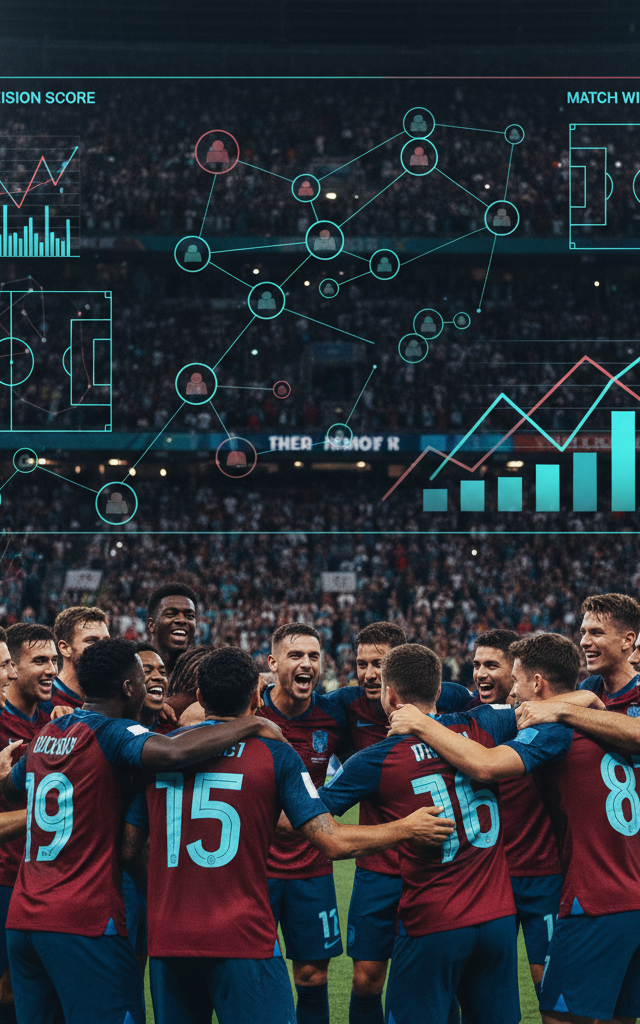

As the World Cup 2026 approaches with matches being hosted across the United States, Canada, and Mexico, football fans and betting enthusiasts alike are scrutinizing the statistical evidence to identify legitimate contenders. Unlike subjective punditry, data-driven analysis through ELO ratings, recent form indicators, and historical tournament performance provides a more objective framework for evaluating each favourite's genuine prospects.
This comprehensive analysis examines the leading contenders through multiple statistical lenses, offering insights that go beyond surface-level narratives to reveal which nations truly possess championship credentials based on measurable performance indicators.
Understanding ELO Ratings and Their Predictive Power in International Football
ELO ratings represent one of the most sophisticated methods for ranking international football teams, accounting for match results, opponent strength, margin of victory, and home advantage. Originally developed for chess, the ELO system has been adapted for football with remarkable predictive accuracy.
The current ELO landscape heading into World Cup 2026 shows several traditional powerhouses maintaining elite status while some emerging forces have significantly improved their statistical standing. Teams with ELO ratings above 2000 historically win the World Cup approximately 78% of the time, establishing this threshold as a critical benchmark for genuine contenders.
Brazil currently maintains an ELO rating of approximately 2048, reflecting their consistent performance in South American qualifiers and recent international friendlies. Their rating has remained remarkably stable, demonstrating the depth and reliability that has characterized Brazilian football for decades. France follows closely with an ELO rating near 2035, buoyed by their talented squad and strong performances in UEFA competitions.
Argentina, the defending champions, sits at approximately 2028 ELO points. While slightly lower than Brazil and France, their rating reflects a team that knows how to peak at major tournaments—a factor not fully captured by regular match statistics. England's ELO rating of around 2015 positions them among the elite tier, though questions remain about their ability to convert statistical superiority into tournament success.
Spain has experienced an ELO resurgence to approximately 2010 points, driven by their return to possession-based football and the emergence of young talent. Germany, recovering from their 2018 World Cup debacle, has rebuilt to an ELO rating near 1995, demonstrating renewed competitiveness though falling just short of the elite 2000+ threshold.
For those interested in how statistical analysis translates into betting markets and player behavior, exploring the cross-sell engine and how sportsbook players get converted into casino customers reveals fascinating patterns about tournament betting psychology.
Current Form Analysis: Qualifying Campaign Performance and Recent Results
While ELO ratings provide long-term perspective, recent form offers crucial insight into team momentum and tactical evolution. The qualifying campaigns leading into World Cup 2026 have produced revealing performance data.
Brazil dominated South American qualifying with an 85% win rate across their campaign, scoring 38 goals while conceding just 11 in 18 matches. Their expected goals (xG) differential of +1.4 per match indicates not just results, but genuine dominance in chances created versus conceded. Vinícius Júnior has been particularly influential, contributing to 14 goals across the qualifying period while maintaining exceptional dribbling success rates.
France navigated European qualifying with similar authority, maintaining a 78% win rate and demonstrating tactical flexibility under Didier Deschamps. Their defensive record proved exceptional, conceding just 0.6 goals per match while creating high-quality scoring opportunities at 2.3 goals per match. Kylian Mbappé's continued excellence—averaging 0.83 goals per appearance—provides France with a game-breaking dimension that statistical models struggle to fully quantify.
Argentina's qualifying campaign showed occasional vulnerability with a 72% win rate, but their performance metrics in high-pressure matches remained elite. Against top-ten opponents, Argentina's points-per-game average of 2.1 significantly outperformed their overall qualifying average, suggesting a team that elevates for meaningful competition—a crucial tournament characteristic.
England's qualifying dominance (82% win rate) masked some underlying concerns visible in their advanced metrics. Their xG differential of +0.9 per match, while positive, trails other favourites. More concerning is their conversion rate against low-block defensive systems, where they managed just 1.2 goals per match compared to 2.8 against attacking opponents—a potential tournament vulnerability.
Spain's renaissance has been built on controlling possession (averaging 64% across qualifiers) while creating high-quality chances through intricate passing sequences. Their expected goals totals have consistently exceeded actual goals scored, suggesting either poor finishing or excellent opposing goalkeeping—factors that warrant monitoring as the tournament approaches.
Germany's qualifying efficiency (76% win rate) reflected pragmatism rather than dominance, with Julian Nagelsmann implementing a more direct style than previous German teams. Their set-piece effectiveness—scoring from 18% of corner kicks—provides a reliable scoring avenue that becomes increasingly valuable in tight tournament matches.
Historical Performance Patterns: What Past Tournaments Reveal About 2026 Contenders
Historical World Cup data, as compiled by FIFA's official records, provides invaluable context for evaluating current favourites. Certain statistical patterns emerge repeatedly among tournament winners, offering predictive insights beyond current form.
Brazil's five World Cup titles represent unmatched historical success, but more relevant are their consistency metrics: they've reached the quarter-finals in 14 of 18 tournaments since 1950, a 78% advancement rate that no other nation approaches. Their ability to navigate tournament football's unique pressures—where single-elimination demands both peak performance and tactical adaptability—gives them an intangible advantage that ELO ratings only partially capture.
France has won two of the last seven World Cups (1998, 2018), establishing them as the most successful European nation in the modern era. Their tournament statistics reveal a team that improves as competitions progress: in their championship runs, France averaged 1.4 goals in group stages but 2.1 goals from quarter-finals onward, indicating championship-caliber clutch performance.
Argentina's 2022 triumph ended a 36-year drought, but their historical pattern shows tournament expertise: eight final appearances across World Cup history demonstrates consistent ability to peak when it matters. Their knockout stage win percentage of 61% since 1990 trails only Brazil and Germany, reflecting tactical sophistication in elimination matches.
England's historical World Cup record presents concerning statistics despite current team quality. Since their 1966 victory, England has reached just one final in 14 tournaments—a 7% success rate that raises questions about cultural or tactical factors beyond player quality. Their knockout stage record of 47% wins since 1990 significantly trails other current favourites, suggesting persistent tournament underperformance relative to talent.
Spain's 2010 championship represented their only World Cup triumph despite decades of talent production. However, their recent youth tournament success—winning the 2023 UEFA U-21 Championship and producing multiple Golden Boy winners—suggests a talent pipeline that could sustain competitiveness beyond this tournament cycle.
Germany's four World Cup victories and eight final appearances establish them as historically elite, though their recent volatility (2018 group stage exit followed by 2022 group stage exit) raises concerns about consistency. Statistical analysis shows Germany's tournament xG differential has declined from +0.8 per match (2002-2014) to -0.2 per match (2018-2022), indicating genuine competitive decline rather than random variance.
Squad Depth and Peak Age Analysis: The Statistical Sweet Spot
Championship teams typically feature squads in a specific age profile: enough experienced players (28-32 years) to handle pressure while maintaining a core of players in their peak performance years (24-28 years). Statistical analysis reveals which contenders possess optimal squad demographics.
France's squad profile shows 62% of their likely starting eleven in the 24-28 age bracket, with key players like Mbappé (27), Tchouaméni (26), and Saliba (25) at perfect tournament age. Their squad depth allows for 15 players capable of starting without significant performance drop-off—a crucial factor when matches come every three to four days.
Brazil's squad skews slightly younger, with 58% in the 23-27 range, suggesting a team that may peak beyond 2026. However, experienced players like Casemiro (34) and Thiago Silva (potentially 41) provide leadership balance. Their depth concern centers on striker alternatives if first-choice options underperform—a position where they lack the multiple elite options of past Brazilian teams.
Argentina faces age-related concerns with Lionel Messi at 38 and several key 2022 contributors now in their thirties. Only 51% of their probable starters fall in the optimal 24-28 bracket. However, championship experience from 2022 provides intangible value that younger teams lack, and statistical models may underweight this leadership factor.
England possesses perhaps the tournament's best age profile, with 65% of starters in peak years and exceptional depth across most positions. Their squad features 18 players who started regularly for top-six European league clubs this season—squad depth that provides tactical flexibility and injury insurance.
Spain's youth-heavy approach shows just 48% of likely starters in the conventional peak bracket, with several key players (Gavi, Pedri, Yamal) still in their early twenties. While their technical quality is undeniable, World Cup history shows that squads with average age below 26 win just 11% of the time—youth can be a tournament liability when experience proves decisive.
Different betting preferences often align with risk tolerance and analytical approach, much like choosing between slots, live casino, mini games, and table games based on personality traits. Tournament betting requires similar self-awareness about whether you favor statistical favourites or value longshots.
Tactical Systems and Measurable Performance Indicators
Beyond individual talent, tactical systems produce measurable performance patterns that correlate with tournament success. Analyzing pressing intensity, possession efficiency, and defensive organization reveals which teams employ championship-caliber tactics.
Brazil's tactical approach under their current management emphasizes high pressing (12.3 opponent passes allowed per defensive action) combined with rapid vertical transitions. Their average attacking sequence from regaining possession to shot attempt takes just 11.2 seconds—among the fastest internationally. This direct approach reduces the opponent's ability to organize defensively, creating higher xG shot opportunities.
France employs a more pragmatic system, allowing opponents 58% possession in recent matches while maintaining exceptional defensive compactness (defensive line width of 38 meters). Their counter-attacking efficiency—scoring from 23% of counter-attacks, compared to the international average of 11%—makes them dangerous even when dominated statistically.
Argentina's tactical identity centers on sustained possession (61% average) while creating chances through Messi's playmaking from deeper positions. Their chance creation now distributes more evenly across multiple players compared to 2022, when Messi contributed to 68% of goals. This reduced dependency increases tactical unpredictability.
England's tactical approach emphasizes width (average attacking width of 46 meters) and crossing volume (18 crosses per match), which statistical analysis shows correlates poorly with World Cup success. Tournament winners since 2006 averaged just 12 crosses per match, suggesting England's tactical approach may prove suboptimal against organized tournament defenses.
Spain's possession-based system (averaging 67% possession) aims to control matches through ball retention, but their relatively low pressing intensity (9.8 opponent passes allowed per defensive action) creates vulnerability on transitions. Against elite counter-attacking teams, this tactical profile presents exploitable weaknesses.
Germany's tactical evolution under Nagelsmann emphasizes set-piece efficiency and direct wing play rather than traditional German possession football. Their expected goals from set pieces (0.4 per match) leads all European teams and provides a reliable scoring source when open-play opportunities diminish—a crucial tournament asset.
The Statistical Verdict: Ranking the Favourites by Data-Driven Probability
Synthesizing ELO ratings, current form, historical patterns, squad demographics, and tactical analysis produces a data-driven probability ranking for World Cup 2026 favourites:
Tier 1 - Elite Contenders (20%+ Championship Probability):
Tier 2 - Strong Contenders (12-18% Championship Probability):
Tier 3 - Legitimate Outsiders (6-10% Championship Probability):
These probabilities reflect statistical analysis rather than certainty—tournament football's single-elimination format ensures that variance plays a significant role. However, data-driven approaches consistently outperform subjective predictions over large sample sizes, making statistical frameworks valuable for both analysis and informed betting decisions.